
How Our Family Saved Over $1000 a Month on Food
This expense was “eating” up a huge chunk of our monthly budget… and we had no idea! With this one change we were able to save enough money to live comfortably on one income.

Updated March 2024 — Originally published in 2015, this post detailing our family’s easy weekly food budget is still our #1 most visited blog post of all time! Keep reading to learn exactly what our family did to save money on our food budget and live comfortably on one income.
How Can I Afford to be a Stay at Home Mom?
As a member of mommy support groups, I frequently see the question posed: how can I afford to be a stay at home mom?
I’ve been a working mom, so I get it that some of us crave “adult time” and enjoy career accomplishments. But I also know what a crappy feeling it is to leave your kids in the care of someone else all day.
Ultimately, I made the choice to leave the corporate world and I wanted to share the one lifestyle change that made it possible.
Note: This post contains affiliate links to the products and apps that helped make our weekly food budget successful, so you can try them too. Read our disclosure policy here.
The One Lifestyle Change That Allowed Me to be a Stay at Home Mom
In November 2015, I quit my job. The plan was for me to enjoy the holidays with my family and start the search for a better employer in the new year. I did that, and things went so wonderfully that my husband and I decided it would be best for our family (and my health) if I stayed home indefinitely.
There was just one problem— we cut our income in half.
While I was working, I always stressed about money. Even with two solid paychecks, it never felt like enough. How would we be able to make it on just my husband’s income?
Aside from monthly non-negotiables (housing, utilities, insurance), there was one expense that dwarfed them all. Once we seriously reevaluated our spending in this area, it freed up a huge chunk of our budget.
I’ll give you a hint: it wasn’t our cable bill…
It was FOOD.
My husband has always loved to cook, and did so on a regular basis. However, we never planned out meals for the week. As a result, we were forced to pop in to the grocery store on multiple occasions throughout the week for whatever he decided to fix on a whim, or pick up take-out when we were short on time.
It seems hard to believe that food could have such an impact on the budget, so to prove it, I’ll show you what we used to spend.
Our former food “budget”
Wait!! Before you read the numbers below, keep in mind that I originally wrote this post in 2015, almost 10 years ago. As we all know, groceries and restaurant meals cost more now. In 2024 money, these numbers would probably be almost DOUBLE!
Here were our food expenses in 2015:
- $240 – We made at least 3 grocery trips every week, spending about $80 each time. Going to the grocery store without a list means you’re likely to forget items and end up having to return later. Multiple visits make it easier to succumb to impulse buys, as you are tempted over and over.
- $160 – We ordered take-out about four times a week. Whether for lunch or dinner, with tax and tip it’s about $40 for our family.
- $50 – While working, I spent about $10 per day on lunch.
- $50 – Hubby also would order out food at work.
Add that up and you get $500 in one week! That’s $2000 every month — wow! This doesn’t even take into account any occasions where we would go out to eat in a restaurant.
It was money we spent without even thinking — we had to eat, right?
And again, in 2024 money, that would probably be more like $4000, which is just wild!
The Weekly Food Budget That Saved us Over $1000 a Month
It was actually my husband’s idea to start weekly meal planning. Amazingly, a commitment to this one concept was the key to a budget that worked.
On Sunday evenings, my husband and I sit down and talk about what we’d like to eat for dinner each night. To make it easier, we’ve designated days such as “Salmon Mondays,” so all we have to decide is sauce and sides. Other days, my husband might have a new recipe he wants to sample. When the week’s menu is determined, we make the grocery list so we know exactly what needs to be bought.
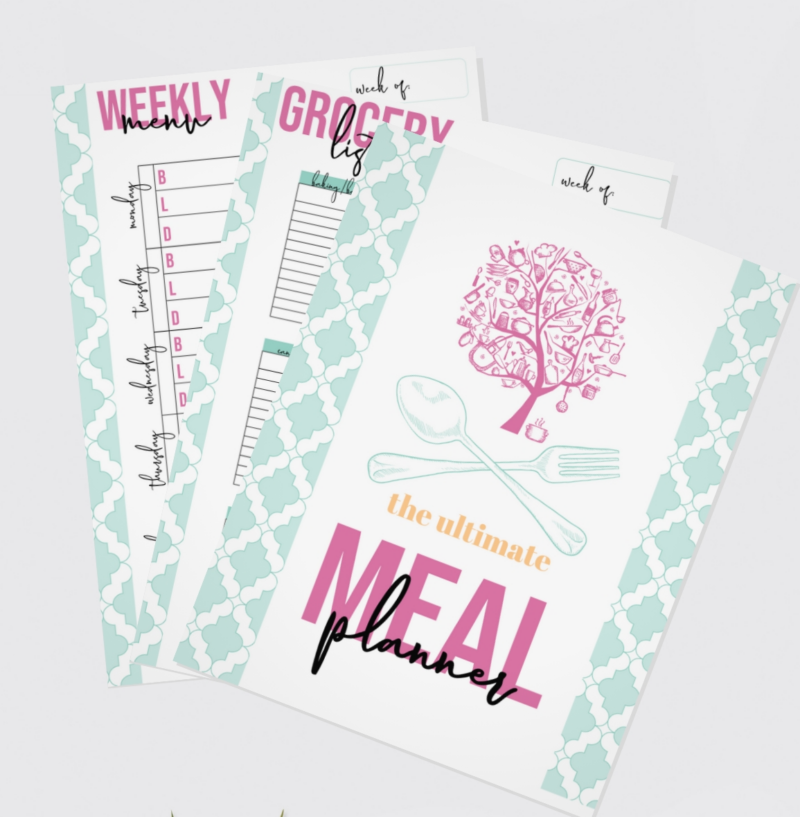
Want to start meal planning…but not sure where to start? Grab The Ultimate Meal Planner Bundle and make keeping track of your weekly meal plan and food budget a breeze! It’s only $6 and worth every penny!
Why meal planning works
- No more inefficient daily trips to the store. We figure everything out in advance, which allows us to grocery shop once a week.
- Impulse buys are a thing of the past. We go in with a plan and don’t end up buying things that aren’t on our list.
- Bye-bye-expensive restaurant meals. Since we’ve got a meal planned for each night of the week, we don’t need to order take-out because we’re hungry and unprepared.
- Lunch is no longer a separate expense. My husband cooks for an army, so there are always plenty of leftovers for lunch.
Here’s a look at our weekly food budget now:
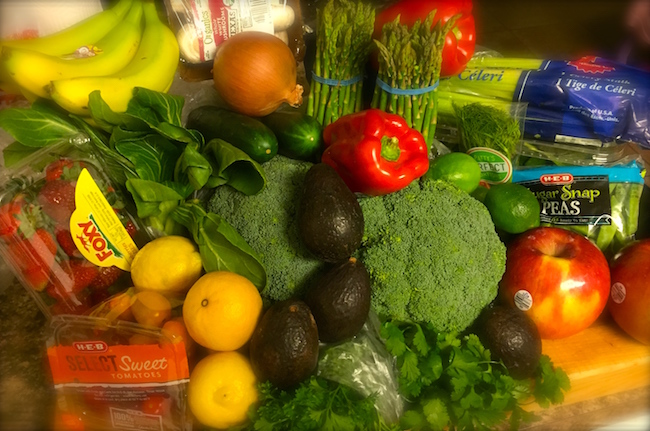
- $150-200: One grocery shopping trip for the ingredients needed for dinner every night of the week.
- With our couponing experiment, we slashed our weekly grocery bill to only $100-140, so our monthly food total averages less than $600!)
- We also stock up on pantry essentials and save money buying in bulk. Click here for our free pantry checklist!
That’s it. We’ve gone from spending $2000 a month on food to no more than $600.
It’s an incredible change and all it took was setting aside 30 minutes on Sunday night to create a meal plan.
If you think about all the time saved by consolidating grocery trips, it might actually be less time to meal plan than to try to go through the week without one.
Of course, we’ve made other adjustments to our lifestyle since I left my job, but none as significant as the meal plan. Maybe it sounds overwhelming to cook every single night, but just look at how much money you can save (for us it was more than $1400 a month!)
An added bonus is that when you cook your own dinners, you know exactly what you’re getting — it’s healthier! (This helped me with my weight loss after baby).
Even if you don’t aspire to be a stay at home mom, you could put up to an extra thousand dollars in the bank every month. That’s a weekend vacation!
If you take a realistic look at what you’re spending on food, you might find that you don’t want to “eat up” a large portion your income any more.
And yes, this even works in 2024.

Our Meal Planning Essentials:
Here are some of the tools and apps we’ve used to help save money on groceries and our food budget:
- Money-saving apps to get cash back on groceries — My absolute favorite is Ibotta — I save more with their rebates than I do with coupons and I get the cash back right away! Plus you get $10 just for signing up!) Click here to sign up for Ibotta through my special link and claim your $10 welcome bonus!
- The Ultimate Meal Planner Bundle — Our customizable printable set makes it easy to keep track of what you have on hand, plan shopping trips and weekly menus, as well as save favorite recipes for years to come… and it’s only $6! Click here to grab one and make meal planning a breeze.
- This magnetic dry erase calendar is awesome for keeping your menu handy on your fridge & these magnetic hanging dry erase markers (you’ll never lose them!)
- Gallon Freezer Bags (Not only do you save money buying them in bulk, but you’ll be less likely to run out! These are a must-have for freezing meat when you find it on sale & stock up!)
- Plenty of storage containers for keeping leftovers fresh
- Vacuum sealer for maximum freshness and even more savings! We have the Food Saver brand!
- eMeals meal planning app which provides weekly menu plans, builds your shopping list, and integrates with your favorite grocery store’s pickup and delivery apps!
More Money Saving Tips
- 7 Ways to Make Meal Planning Easier
- 5 Steps to Save $10,000 in One Year
- How we Lived Well for a Year on $30,000 – A Yearly Budget That Works
- How to Have an Awesome Christmas on a Budget
- 4 Keys to Living Well as a One Income Family
- How to Stop Worrying About Money
This really has changed our lives and I’m so excited to share it all with you! There’s no reason you can’t start saving money right away too!


- Baked BBQ Salmon (Easy 2 Ingredient Recipe) - October 20, 2026
- Easy Pumpkin Pudding (Ready in 10 minutes!) - October 16, 2026
- Spider Lollipops Halloween Craft - October 1, 2026




I wish I had a take home pay of $500. I’m amazed that much money can be lost so easily.
Hi Lorraine, thanks for reading! It definitely was very eye-opening how much money we were spending without even knowing it.
I have been tracking how much I spend on lunch each day at work and it is crazy to see that I too spend on average $10 a day! Way too much! It is something you don’t even think about!
Absolutely! Individual lunches don’t seem very expensive on their own, but buying lunch every day can cost a couple hundred bucks a month–yikes! Bringing leftovers from the night before cut that expense out completely, and it’s healthier because you know exactly what you’re eating.
I recently stopped working and went back to being a stay at home momma as well. I try my hardest to meal plan before I go food shopping but doing so while chasing around a 2 year old is hard. My new goal is to do this on Sunday night as well, with my husband after the baby goes to sleep. I’ve been wanting to create a recipe book as well. This seems like a good time to do so. Seeing those amounts made me realize I’m doing the exact same thing.
Once you start meal planning and see the money you can save, you’ll never look back! It’s addicting to check the weekly sales, couponing sites, and apps to see how much I can lower our shopping totals– I’m slowly getting better at it 🙂 Check out my posts on our “Couponing Experiment” for more ideas! Thank you for reading!
Is there a way to convince people to do this? I keep trying to mention it to my parents (who blow through about $250+ a week on groceries) but they act like it’s the stupidest idea. That, or they don’t think a 19 year old knows anything about saving.
Perhaps ask if they will let you help them try this for one week. The results might be enough to convince them it’s worth it! Once we saw how much money we could save, there’s no way we could go back to our previous spending habits.
I love this post! I recently quit my career of 10 years to stay at home. It’s amazing how much money I spent on coffee, work lunches, and dining out for dinner time because I didn’t plan ahead.
Thank you, I’m glad it resonated with you! At first it’s almost unbelievable when you see how much money you used to spend, but it is a lot of fun to start finding ways to save and seeing those results pay off. Congrats on becoming a SAHM by the way! 🙂
I have a $500 monthly budget for family of 6. first thing I do every time I shop is to hit the clearance section, discounted produce, and manager discounted meats (they are marked with yellow stickers–I call them my happy stickers!).
Most people don’t buy organic meats/produce, so I wait until they get their “happy stickers” and am able to buy better food at a price equal to or lower than conventional foods
I also hit BIG LOTS and find even organic foods for below clearance prices. I stock up this way and am able to stretch our budget and feel good knowing I am feeding my family quality food.
Most meals are homemade. I am blessed to be able to do that.
Thank you so much for sharing– these are excellent tips! We also look for the “happy stickers” (love the nickname) on meats, but I’ll start looking for them on organics too. I’m so impressed by what you are able to do 🙂
I know it’s been a couple months since you posted, C, but I have to say thank you! What great ideas. I too have a family of 6, and a $500/mo. grocery budget. Your tips are a godsend!
Thanks for a helpful article, Stacey. Happy New Year!
So glad you found some great ideas here Sarah! Happy New Year to you too!
I found this on Pinterest. I am a lot older, and it’s been a while since I was feeding small children at home. I congratulate you on taking control of your budget. A lot of people never bother to even check what they are spending at the supermarket. In time, this will be so natural you’ll have all the prices, ingredients and menus in your head; you won’t need Moleskine notebooks (hint: they are incredibly expensive — get a generic notebook).
$500 sounds a little low for 4 people, but I assume your children are very small. As they grow, you will have to increase this. By the teen years, you will have to buy adult sized (or bigger!) portions for them. I suggest you start NOW, figuring out what you spend per adult and per child. It will be a good guide.
Most folks have already given you the good advice: shop sales. Shop mark-downs and near-expiration date items. They are fine if you freeze or use immediately. Every store has this, you need to learn where they put this stuff and what days they mark down on (often a Monday, or after a holiday). Use a coupon on a markdown and you really save.
I was pretty startled you both ate lunches out every single day, at $10 a pop. $100 a week? I would have freaked out about that long before having kids! Pack a salad or sandwich, and you can cut that by 75%. It’s also healthier.
$2000 a month for groceries, for 2 adults and 2 kids is literally the most I have EVER heard of ANYONE spending. I’m glad you got this under control. It’s well worth it.
The only drawback: you are saving about $1500 a month, or $18,000 a year. That’s fantastic. But unless your job was “Walmart greeter”, it isn’t enough to make up for staying home. (I mean financially; it has a value for your children far beyond dollars & cents.) But you seem so creative and willing to work hard at savings, I am sure you’ll find a myriad of other ways to save big! Good luck!
Hi Lola! Thank you so much for reading and for your insight. I definitely have received feedback from some that were shocked by our spending, but I wanted to be honest to show that it doesn’t matter what your past habits were, you can always make positive changes!
All of my figures are estimates, so there might have been some days where I spent $7 instead of $10 on lunch, or the occasional day I brought leftovers (before I made that my habit), but it is easier to round up and keep the numbers even– but you get the idea. I’m willing to bet that there are many other working moms (and dads) who don’t think anything of spending a few bucks here and there for lunch or coffee, because it seems like such a minor expense, but if you do it every day it does add up!
As a management-level professional, I definitely was making more than minimum wage, and you’re right, meal planning alone wouldn’t cover my salary. However, this was the catalyst to evaluate ALL of our spending habits. Also, when I’m home most of the time, I’m not buying gas, going out for happy hour after work, buying pricey work clothes, or paying for a housekeeper. With me home our expenses went down a lot too. (I’m finishing up an ebook which will detail everything we’ve done to make our this lifestyle work for us, as well as a typical week’s menu).
Thanks again for reading and for sharing your thoughts! I always appreciate feedback!
IMHO, you get major points for tracking and budgeting (and extra credit for sharing — THANKS!)
Don’t forget that if you were to add up your other savings (no more corporate clothes/shoes, dry cleaning, work travel expenses and vehicle wear and tear, etc.), that, added to your lower grocery costs, brings your salary “coverage” total quite a bit higher than that commensurate with a former job as a Walmart Greeter.
While it is certainly true that not every family has the choice to designate a stay-at-home parent, when both salaries combined are truly needed to cover living costs (even with careful budgeting already), but it sounds like your husband’s salary is able to cover more than half, so it becomes do-able for your family with careful tracking and belt-tightening. The point you make so well is that most of us can look to our food budgets to be able to cut the fat in more ways than dietary.
I hope you are still socking away emergency and retirement savings, however – as your family learns to further tighten its belt. For another reason, I deferred those expenses much longer than was prudent, and am paying for it now. Don’t make my mistake.
xx,
mgh
(Madelyn Griffith-Haynie – ADDandSoMuchMore dot com)
– ADD Coach Training Field founder; ADD Coaching co-founder –
“It takes a village to educate a world!”
Thank you so much for your encouragement Madelyn! It IS a little scary to put yourself out there and talk about something so personal as money and finances– it definitely opens the door for criticism. However, I wanted to share in case I could help others like me to take a look at their spending and maybe free up some money for other important things (even if they are not trying to be a SAHM). And yes, we do have an emergency fund and have started a retirement savings (neither one of us have ever been offered 401K through work). I have wonderful financial mentors in my Granny and my Dad that have set great examples of realistic money habits. I’m glad you took the time to read and thank you again for your kinds words! (My favorite type of comment haha) 🙂
You are most welcome. You deserve applause for bravery and sharing, NOT criticism because your experience didn’t directly relate to everyone else’s.
Thanks for responding to my savings comments. I did NOT have great financial mentors, so I made a lot of mistakes which follow me to this day (they were great money *managers,* but they didn’t think it was any of my business, as a kid, how they did it – and that set the tone for life). I’ll admit I was a bit worried that maybe I would come across more like know-it-all than someone who was simply trying to be helpful.
Thanks for putting my mind to rest. Again, great blog – I’ll be back. xx, mgh
Thank you for your honesty! It’s refreshing! I see a lot of “we only spend $200/month on groceries” and I feel too awful to proceed and in return, don’t get the advice! To be honest, I cut ours down from $1,500-$2,00/month for the four of us (we’re GF and half DF and one severe nut allergy) we eat all organic and no refined sugar. With planning, and just not turning into the fast food parking lot, we have cut it down to $1,200/month, sometimes $1,000. Because of the restrictions diet wise, I usually shut my mouth and run when I hear moms comiserate about their grocery bills. Thank you for not making me feel bad about that number!!
I can tell a difference with cutting down on going out and a little planning, we even FEEL better. Now, our cheat is to run out and buy frozen pizzas instead of ordering.
The one thing that really helps was Costco. We chose them because they treat their employees well and give benefits to them. If they have a dry good or non-perishable on sale, I’ll stock up. I’ve crunched the numbers and bulk is the way to go.
I know you don’t coupon, neither do I, but walking into Anywhere with RetailMeNot ROCKS. Cartwheel by Target is also fabulous. Usually the signs don’t match the fine print on the Cartwheel app (you end up saving MORE).
Thank you,
Marino Family
Your comment made my day!! Thank you for letting me know you appreciated this — it is exactly the reason I decided to share our financial journey 🙂
I just started meal planning to stay within our $300/month grocery budget. I only eat out twice month at work and I’ve now began to make meals on saturday to eliminate eating out on the weekends. I’ve started to see the difference in our budget and think it will be something that we stick with.
That is awesome that you are able to stick to your budget! Cooking on Saturdays definitely does help 🙂
I think it’s time for me to do a hard reset on how I buy food. We have five kids, and buying for seven people – well, I wont tell you what we spent every month. My oldest daughter got married last month, one of the boys moved into a place near campus, another daughter is looking for a place right now – and another son will likely try to piggyback her (if she lets him) so he can live closer to campus/away from parents. That would leave three of us instead of seven.
I don’t even know how to start.
Hi Velezita! Start with baby steps if that’s what is easiest. Look for one way each week that you can make a change in your habits. If you usually go out to eat on on the weekends, try cooking in one day instead. The weekly sale ad at your grocery store will also let you know what is the best deal and you can save big that way too. I’m actually working on my ebook which will tell exactly what we did step-by-step from the beginning to where we are now. Don’t be embarrassed by what you spend– just make a commitment to shop a little bit smarter 🙂 Everyone has to start somewhere!